October 2026 Newsletter
A Word from our President

by – Tom Tallon-Alpha HVAC & Plumbing
KCCA – A Message from Tom, President
Subject: Get Ready for Furnace Season – Join KCCA!
Dear HVAC Contractors,
As the weather begins to change from hot summer days to cooler fall temperatures, HVAC companies are gearing up for one of the busiest times of the year: furnace maintenance season!
This is an important time to prepare your customers’ heating systems for the colder months ahead, ensure equipment is operating safely and efficiently, and help homeowners stay comfortable throughout the winter.
At KCCA, we understand the challenges and opportunities that come with each heating season. We encourage HVAC contractors to stay connected, share knowledge, build relationships, and take advantage of the resources our association offers to help strengthen our industry.
Have you heard about KCCA? Now is a great time to find out what we’re all about!
We are excited to offer new HVAC-licensed contractors who have never been KCCA members a FREE ONE-YEAR MEMBERSHIP! This is a great opportunity to learn more about our association, connect with other professionals, and discover how KCCA can support your business and professional growth.
Join us on November 16th to learn more about KCCA, meet fellow contractors, and see how becoming a member can benefit you and your company.
Whether you are an established contractor or just getting started, we welcome you to come see what KCCA has to offer.
We look forward to meeting you and helping you make the most of the upcoming heating season!
Sincerely,
Tom
President, KCCA
Tom Tallon-Alpha HVAC & Plumbing
Please feel free to contact me with any questions,
tomt@alpha-heatair.com or Office 316-260-5775

EDUCATION

MABCD Newsletter
Click here to get the latest updates on Mechanical, Electrical and Plumbing changes to code.
2026/2027 Meetings
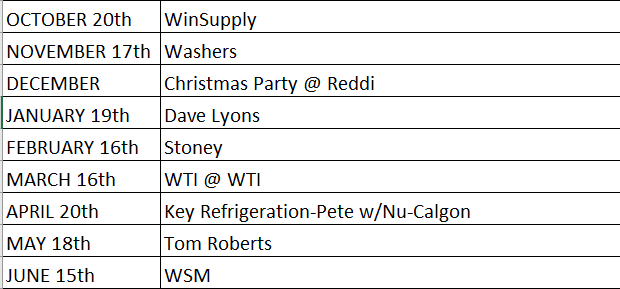

September’s General Meeting
Last months general meeting was a GREAT turn out for the speaker Jeff Stevevson from Federated. We had some new faces in the room and everyone got a 1hr CEU hour.
Hope to see you @ future meetings!! All general meetings are held on the 3rd Tuesday, except no meeting in July or December.
Price Increases Remain Part of the Residential HVAC Outlook
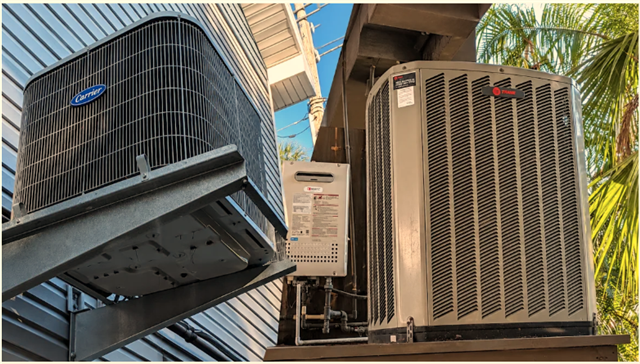
Carrier and Trane see strong demand as higher input costs continue to pressure pricing
September 18, 2026
A year ago, the mood around residential HVAC at the annual Morgan Stanley Laguna Conference was decidedly downbeat. Leaders from various manufacturers pointed to cautious consumers, high interest rates, inventory challenges, and a stubborn repair-over-replace trend as signs that the market would remain difficult well into 2026.
At this year’s conference, the tone was markedly different. Carrier and Trane Technologies said residential demand is meeting or exceeding expectations, despite many of the same economic headwinds that weighed on the market a year ago. But the stronger market has not eliminated pricing pressure, as both manufacturers say price increases are necessary to offset higher input costs, including tariffs and other inflationary pressures.
Carrier Reports
Carrier expects both its U.S. residential and light commercial HVAC businesses to post high-single-digit growth this year, with performance running ahead of expectations. CEO Dave Gitlin said the residential business is performing “far better” than Carrier had expected internally, and light commercial surprised the company as well.
“The third quarter looks quite good,” he said.
Gitlin said part of the residential improvement reflects easier comparisons, because Carrier is no longer dealing with the destocking that affected results last year. He also credited higher pricing, noting that “we’re usually the first to drive price in a competitive, aggressive way,” as well as market share gains.
For example, in new construction, Gitlin said the company has added customers and won business based on relationships, delivery, quality, and cost rather than simply price. Despite taking an aggressive approach to pricing, Carrier estimates it has gained about 30 basis points of residential market share.
Higher prices remain necessary as Carrier faces increased input costs, including tariffs, fuel, copper, steel, and aluminum, Gitlin reported. He said the company has been pushing through price increases and may consider additional out-of-cycle increases. However, he emphasized that current conditions are different from 2022, when Carrier raised prices by roughly 8% several times over an 18- to 24-month period.
“We can’t raise price 8% every four months, but we can and will continue to raise price,” he said.
Underlying residential demand is also stronger. Gitlin said the U.S. market is now tracking at about 7.5 million units this year, above Carrier’s earlier expectation of roughly 6.5 million to 7 million. While that remains below the 9.2 million units sold in 2024, he said conditions are improving. Gitlin attributed the stronger-than-expected market partly to pent-up housing demand and said the repair-over-replace trend seen last year has “largely subsided.”
Carrier also expects continued strong growth in its U.S. commercial HVAC business, with data centers playing a major role in the company’s outlook. Gitlin said global commercial HVAC orders were up more than 50% in the first half of the year, helping push Carrier’s total company backlog to a record $8 billion. He described U.S. commercial HVAC demand as particularly strong and said commercial sales in the Americas are expected to exceed residential sales within the next couple of years.
Data centers are a key driver. Carrier expects about $2 billion in data center revenue this year, with roughly $1.5 billion coming in the second half. Gitlin said the company feels confident in delivering that volume because it has passed key customer-witnessed technical tests, expanded sourcing for critical components, adjusted parts stocking strategies, and trained technicians for every production shift.
“We are very well positioned there,” he said.
Looking to 2027, Gitlin said $3 billion in data center revenue would be a reasonable minimum based on Carrier’s current backlog, pipeline, and capacity. The company plans to open a new U.S. site in either Texas or Alabama that will double existing capacity. That facility is being designed to produce both data center and non-data-center equipment, giving Carrier flexibility to serve sectors such as health care, higher education, semiconductor manufacturing, renewable energy, and infrastructure.
Trane Update
Trane Technologies is also experiencing continued strength in its U.S. commercial HVAC business, with data centers contributing to a broader increase in demand across multiple vertical markets. CEO Dave Regnery said the company’s pipeline is “probably the most I’ve seen in my career in this industry,” while second-quarter commercial HVAC Americas orders were up 50%.
Data centers remain a major growth driver, but Trane emphasized that the opportunity extends well beyond that sector. CFO Chris Kuehn said all 14 commercial verticals that Trane tracks grew in the second quarter, specifically pointing to continued strength in higher education and improving conditions in the office market.
Within data centers, Trane is focusing on complete thermal management systems rather than individual pieces of equipment. Regnery said the company is working with hyperscalers and chip manufacturers on designs that combine chillers, coolant distribution units (CDUs), cold plates, and electrical infrastructure.
“We’re not selling a product. We’re selling a solution. We’re selling a system,” he said.
Regnery also said most current data center projects use air-cooled or closed-loop systems, with “smart” chillers increasingly able to optimize when to use compressors versus free cooling.
“That same technology is being deployed right now not only in data centers, but in schools, in hospitals, wherever it’s applicable,” he said. “It’s all about efficiency. It’s all about how you generate a system that’s different and more competitive for our customers.”
To meet the demand, Trane has expanded its applied-system manufacturing capacity fourfold over the past three years and continues to add capacity where needed.
“We know what our pipeline is,” said Regnery. “We know what our commitments are, and we have a business operating system that helps us make sure that we stay in front of that, and we plan on doing that.”
The strength is not limited to commercial HVAC. Residential, which accounts for about 15% of Trane Technologies’ business, is expected to grow at a mid-single-digit rate this year, with channel inventories now back in balance. Regnery said Trane made the decision late last year to reduce production and “get our inventory right going into 2026,” and he said the company now considers residential inventory levels to be in good shape.
On pricing, Trane has already implemented two residential increases this year: one effective April 1 and another July 1, both for up to 5%. Kuehn said pricing decisions are based on input costs, demand, and what the company can offset through supply-chain actions.
“Pricing is a lever that we’ll kind of have to implement to ultimately have that cost versus inflation balance out,” he said.
Kuehn said price versus inflation was a headwind in the first half of the year and is expected to remain a headwind in the second half. He also emphasized that residential pricing is highly localized, describing it as “really a zip code by zip code space where you’re making decisions on price.” Through the end of July, however, Trane was achieving the pricing yield it expected from the increases already announced.
While Regnery declined to provide intra-quarter residential demand guidance, he noted, “It’s been pretty hot out this summer. In North Carolina, I was out walking yesterday, and it was 100ºF. I was like, ‘This is crazy.’ So we’ll see.” For now, Trane is maintaining its full-year outlook for mid-single-digit residential growth.
Funny Photos




Reducing Accidents With Regular Housekeeping
Poor housekeeping can correlate directly to slips, trips, and falls at workplaces, which can result in serious injuries, costly claims, and lost productivity.1 Maintaining a clean and organized workspace is one of the simplest ways to help protect your employees and clients.
Where Do You Start?
Establishing a routine housekeeping plan is a solid first step. Consider incorporating the following practices at your business:
•Keep floors clean, dry, and free of clutter
•Ensure walkways and emergency exits are clear at all times
•Clean up spills and place wet floor signs where needed
•Store materials and equipment in designated areas
•Dispose of waste regularly
•Avoid letting grease and dirt build up on machines and equipment
•Inspect and repair damaged flooring, handrails, and lighting
•Make sure that electrical cords are routed away from doorways and not run under rugs or carpets
•Use proper flooring covers at entryways to reduce slips from tracked-in moisture
How Often Should You Clean?
Frequency matters. High-traffic areas, such as entryways, restrooms, and break rooms, should be addressed daily. Broader facility walkthroughs should occur weekly, with deeper cleaning and inspections conducted on a monthly basis.
Take Action
Housekeeping at your business is essential to help prevent slips, trips, and falls, and it can make a difference in keeping clients and employees safer during their day-to-day activities. A clean workplace reflects a culture of care and accountability that benefits everyone who walks through your doors.
Reach out to your local Federated® marketing representative to learn more about workplace safety topics and the risk management resources available to you.
1.
OSHA. Slips, Trips, and Falls: Preventing Workplace Trip Hazards. 2023. https://www.osha.com/blog/slips-trips-falls-prevention. Accessed July 23, 2026.